
Which East Ridge Public Records Are Open
East Ridge sits inside Hamilton County, but those two governments do not keep the same files. City departments hold council action, municipal permits, police reports, and ordinance cases. County offices hold deeds, parcel rolls, most trial cases, marriage licensing, and local birth or death certificate service. State systems cover appellate cases, felony custody, and certificate archives. “Open” can mean a free online index, inspection at a counter, or a copy released after a focused request.
| Record group | Responsible custodian | Web access | Public access route |
|---|---|---|---|
| City minutes, permits, police files | East Ridge Clerk or department | Posted files, GovQA, OpenGov entry | Web, phone, counter, or request |
| Deeds, liens, and plats | Hamilton County Register | Account database; earliest online year not stated | Paid portal, counter, email, phone, form, or microfilm |
| Parcel and tax rolls | Assessor and Trustee | Free searches and downloads | Web, bulk files, phone, or office |
| Court cases | Municipal or division clerk | Appellate search only is statewide | Local index, terminal, phone, or case request |
| Vital certificates | Hamilton Health or Tennessee Vital Records | No open recent-name index | Qualified application by local, mail, state, or approved online channel |
| Jail and offender files | Sheriff, TDOC, or TBI | Free public safety lookups | Portal plus originating-agency confirmation |
Access is field-specific. A docket may be visible while a sealed filing is not. A parcel card is open, yet protected motor-vehicle data is not an address directory. Recent vital certificates require entitlement, and military discharge records receive special limits. Voter registration has its own purpose and confidentiality rules, treated in the East Ridge voter records resource.
East Ridge City Records Channels
The City Clerk is the municipal records coordinator. The office keeps council and board minutes, codifies city documents, handles beer permits, and routes requests through GovQA. City Hall is at 1517 Tombras Avenue, and the published counter hours are Monday through Friday, 8:00 a.m. to 4:30 p.m. A useful submission names the department, existing record, person or address, and date span. Electronic native files can be requested when they exist.
The East Ridge City Clerk records page shows the local request route and office responsibilities.
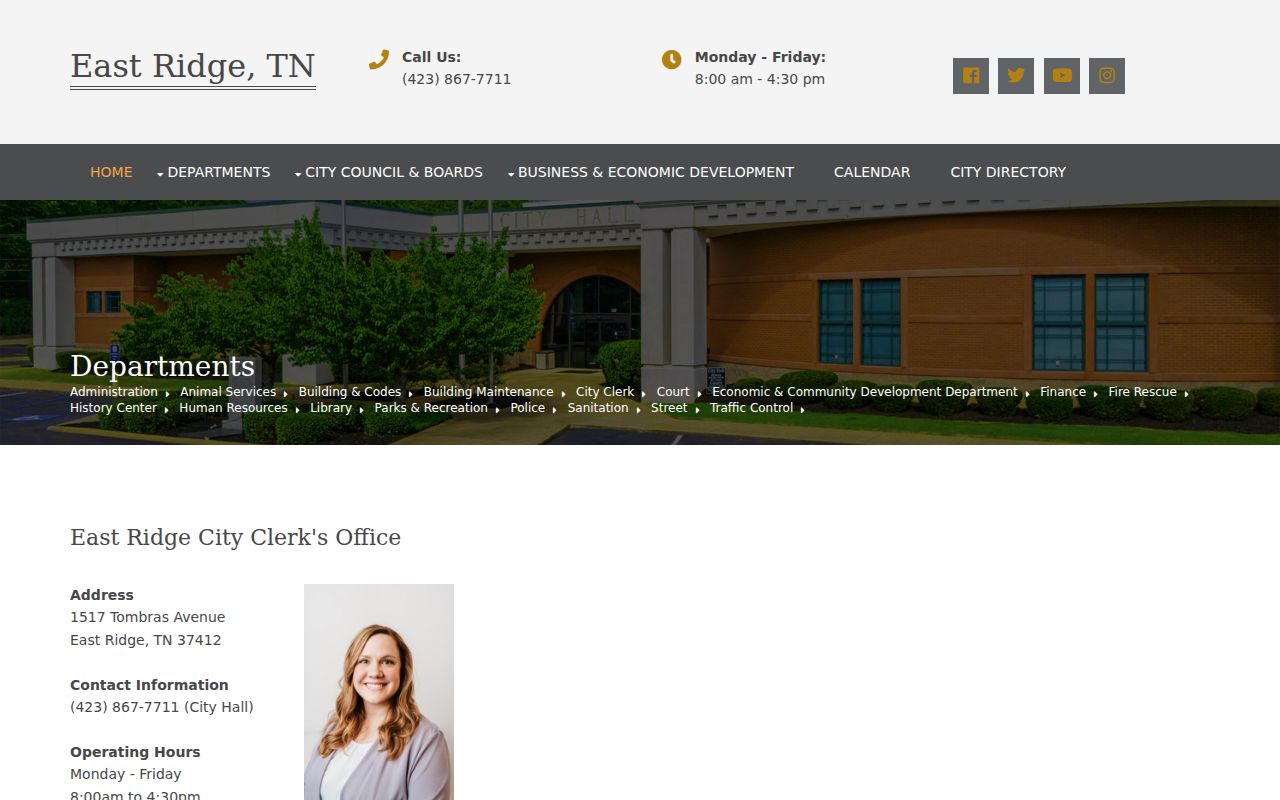
The page confirms that GovQA is the city channel for Tennessee residents, but it does not promise a public search screen for every city file. Building Codes uses OpenGov for permit applications, inspections, and code complaints. Its categories range from building, demolition, and trade permits to plats, rezoning, signs, street cuts, variances, and zoning checks. The site is geared toward transactions, and no verified no-login results index or historical coverage date was found. The East Ridge Building Codes page provides the official OpenGov entry and permit list.
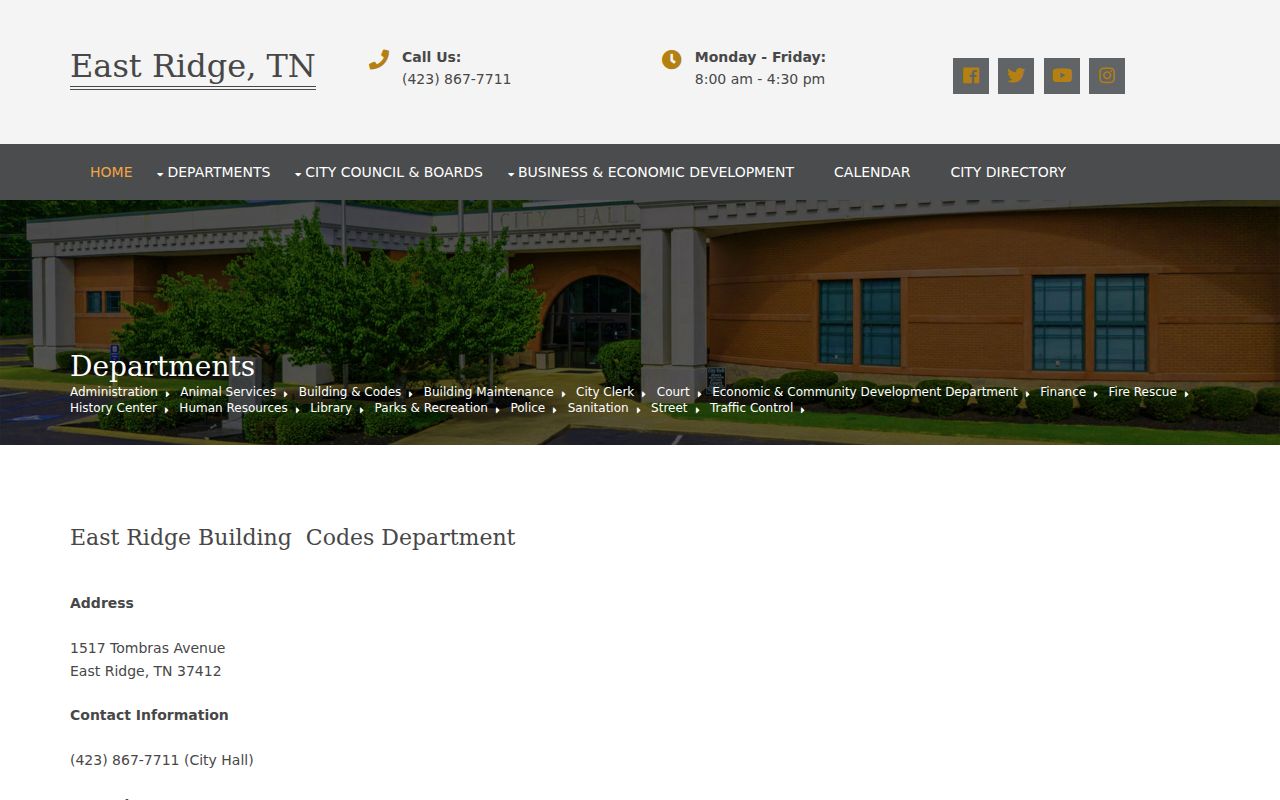
The screen is an access point, not proof that every permit file can be browsed without an account. For an existing permit or violation file, use the address, permit type, and a tight date range in a city request.
East Ridge Deed Records Access
The Hamilton County Register records deeds, deeds of trust, liens, releases, powers of attorney, plats, marriage settlements, and other instruments. Historical deeds reach 1796 through courthouse and microfilm channels. The public landing page does not state the first electronic index year. Modern database access requires an approved account and costs $50 per month, so “online” does not mean free or complete. The Hamilton County Register access page links the search, office forms, fees, and property alert.

This landing page is the best starting point for deciding between an account, a direct copy request, and an office visit. Official instructions identify seven search modes. The controls behind login were not inspected, so hidden subfields and result limits should not be assumed.
| Search route | Input type | Use and limits |
|---|---|---|
| Party | Indexed name | Grantor, grantee, or another recorded party; subfields are gated |
| Book and Page | Text pair | Best after the Assessor supplies the current deed reference |
| Document | Document number | Exact public syntax was not shown |
| Property | Property description | Use Assessor or GIS when address indexing is incomplete |
| Party/Property | Combined limits | Joins a name with property terms |
| Index or Quick | Browse or simple mode | Both remain behind account login |
The Register deed index entry visibly confirms that credentials are needed.
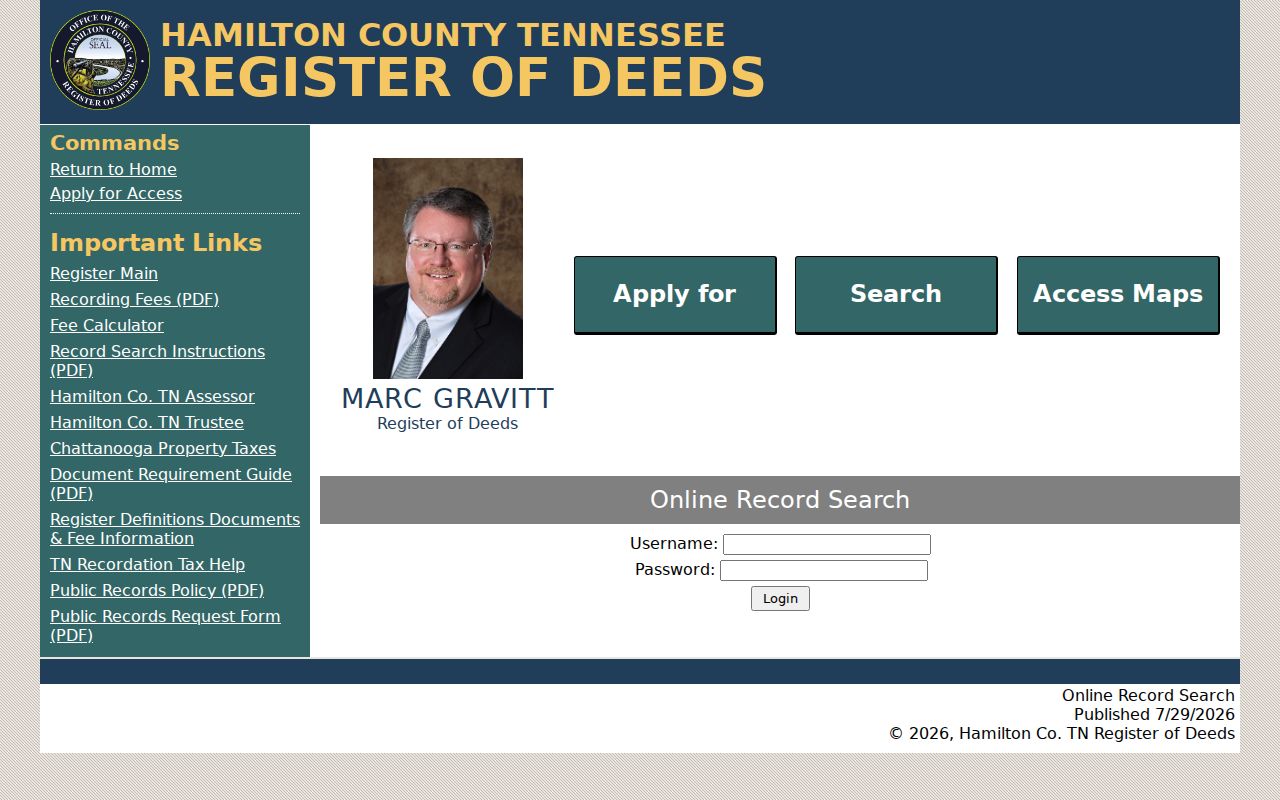
The gated entry explains why free property data and direct Register contact are essential fallback paths. These terms help distinguish a search result from a copy that carries official authentication.
- Index
- A list that points to a recorded item. It is not always the document image.
- Grantor and grantee
- The person giving an interest and the person receiving it.
- Certified copy
- A copy authenticated by the keeper for official use.
- Custodian
- The office legally responsible for keeping and releasing a record.
- Exemption
- A law or rule that closes a record or requires part of it to be removed.
Free East Ridge Property Records
The free Assessor search is the practical bridge to the paid deed system. Search by owner name, property address, or map, group, and parcel number. A parcel card can show the indexed owner, mailing and property addresses, legal description, values, building facts, sale references, and deed book and page. The situs address locates the land. The mailing address, when shown, reaches the owner. They are not interchangeable.
- Search the Assessor by owner, street and number, or exact parcel ID.
- Copy the displayed owner form, parcel number, and deed book and page.
- Use book and page in the Register system, or give them to staff in a focused copy request.
- Check GIS when the city label, ZIP code, unit, or tax map needs to be reconciled.
Hamilton County also posts current Assessor and building files for download, plus Trustee tax-roll and delinquency files. Appraisal data is described as changing every 30 days. The GIS stores CITY and ZIPCODE as separate fields, which matters near the Chattanooga border and Georgia line. An “East Ridge” postal label alone does not establish which municipal office holds a permit.
Cost-saving route. Get the deed book and page from the free Assessor record before paying for broad Register database access.
Why East Ridge Court Records Split
There is no single Tennessee trial-court name portal. East Ridge Municipal Court keeps city ordinance and traffic matters. Hamilton County General Sessions, Circuit, Criminal, Chancery, Juvenile, and probate channels each keep their own case classes. A statewide search at the Administrative Office of the Courts covers appellate cases, not every local pleading, exhibit, or decree. This distinction prevents a blank appellate result from being mistaken for no local case.
Start by naming the court level. Give the responsible clerk a full party name with variants, an approximate filing year, case type, and case number if known. Inspect the public index or terminal, note the docket entry, then request specified pages or a certified judgment. A docket is the dated list of case events. A disposition is the result or status. Older files may need archive retrieval.
Hamilton County’s court routing page identifies the separate court offices. Tennessee Supreme Court Rule 34 allows access to court records while preserving statutory closures, sealing, redaction, and court control. Adoption, juvenile, expunged, sealed, and protected-identifier material should never be treated as open by default.
Note: Federal cases from East Ridge follow Eastern District of Tennessee and PACER channels, separate from city and county clerks.
East Ridge Vital Records Limits
Recent vital certificates are not an unrestricted name search. Hamilton County Health Department can issue Tennessee births from the most recent 100 years and deaths from the most recent 50 years to qualified applicants. Tennessee Vital Records handles birth, death, marriage, and divorce certificates. The County Clerk keeps the marriage-license transaction, while a divorce case stays with the court that granted it.
Births open through Tennessee State Library and Archives after 100 years. Death, marriage, divorce, and annulment records open after 50 years. T.C.A. §§ 68-3-205 and 68-3-206 govern disclosure, including narrower access to cause of death and the removal of confidential application fields. A state certified copy costs $15. The charge applies even when no matching certificate is found.
County birth and death requests may go through the local counter, mail, email, or fax under the published process. State requests may be made at the counter, by mail, or through the authorized online contractor, which adds service fees. A mailed application needs a signed form and either suitable identification or notarization. Historical researchers should shift to the archives after the statutory opening period.
East Ridge Records Offices and Portals
A city request belongs at City Hall only when a city department created or keeps the file. County land, tax, and most court records belong in Chattanooga. Calling the wrong building adds delay, and no records law requires one office to create an answer from another custodian’s data.
East Ridge City Clerk
1517 Tombras Avenue
East Ridge, TN 37412
423-867-7711
Monday through Friday, 8:00 to 4:30
Hamilton County Register
625 Georgia Avenue, Room 400
Chattanooga, TN
423-209-6560
Monday through Friday, 8:00 to 4:00
Hamilton County Assessor
6135 Heritage Park Drive
Chattanooga, TN 37416
423-209-7300
Monday through Friday, 8:00 to 5:00
East Ridge Police Records
4214 Ringgold Road
East Ridge, TN
423-867-3718
Monday through Friday, 7:00 to 4:00
For a deed, the Register also accepts targeted contact by phone, email, or its records-request form. Assessor staff can help with parcel splits and mapping questions, but official deed and plat copies still come from the Register. Court copy charges and access details vary by division, so identify the case before asking for a fee.
East Ridge Police Records Volume
East Ridge Police Records reports processing more than 15,000 reports each year. The division keeps offense and arrest reports, crash reports, and traffic citations. It also provides offense, arrest, and crash copies, plus beer and fingerprint cards, for what the city calls a nominal charge. Because no exact report-copy price was published, ask for the current amount before ordering.
A focused request supplies the incident number, date, location, involved name, and report type. Staff can then say whether redaction or an eligibility rule affects release. The division is at 4214 Ringgold Road and publishes weekday hours of 7:00 a.m. to 4:00 p.m., except holidays.
Custody lookups split by system. The Hamilton County Sheriff inmate search concerns current local custody, including people booked after East Ridge arrests. TDOC’s FOIL system covers Tennessee felony offenders, while the TBI registry has its own name, address, location, offense, and status searches. Portal data should be confirmed with the agency that supplied it, especially when identity or current status matters.
Fees for East Ridge Records
Inspection under the Tennessee Public Records Act is free unless another law allows a charge. An agency should provide an estimate before making paid copies. The statewide reasonable-charge schedule uses 15 cents for a black-and-white letter or legal page and 50 cents for a color page as safe-harbor rates. Labor is generally charged only after the first hour, while storage and vendor costs may be passed through.
| Item | Published charge |
|---|---|
| Register electronic database | $50 per month |
| Certified letter or legal deed page | $1 per page |
| Certified plat | $5 |
| Register computer record by email | 15 cents per page |
| Register microfilm record by email | $1 per page |
| State vital certificate | $15 each |
Inspecting first can reduce copy and labor costs. Ask whether an electronic native file already exists, whether redacted pages add labor, and whether certification is truly needed. A plain informational copy and a certified copy serve different purposes. Broad requests may be narrowed by date, department, address, case, or instrument number.
East Ridge Records Privacy Boundaries
A public index does not make every field public. Tennessee law protects sealed and expunged cases, adoption and juvenile files, recent vital certificates, Social Security and government identification numbers, DD-214 military discharges, motor-vehicle personal data, and protected voter or absentee details. A custodian may release a redacted version when only part of a file is exempt.
Safe at Home gives eligible relocated survivors a substitute mailing address. It does not erase older files or replace the true address on real-property assessment, tax, or recorded land documents. That exception is practical, but it is not permission to defeat the program or pursue a protected person. Prior public availability never authorizes threats or repeated unwanted contact.
The Tennessee Information Protection Act took effect July 1, 2025 and gives qualifying consumers rights against covered private data controllers. Its thresholds and public-record exclusions mean it is not a universal deletion law for government files. Official custodians correct their own records under office procedures; private-data requests go to the covered controller.
Note: Ask for the statute or rule behind a withheld field and request the segregable, redacted portion that remains open.
When East Ridge Records Go Offline
Absence from one database is not absence from Hamilton County. The 1910 county courthouse fire damaged records and destroyed older will books. Fires in James County in 1890 and 1913, followed by its 1919 merger, explain more gaps in eastern Hamilton material. East Ridge incorporated in 1921, so older people and property may appear under Chattanooga or Hamilton headings instead of the later city name.
Digitization arrived in layers. Current parcel data is free online and downloadable, while current deed access uses an account portal. Deeds from 1796 to 1901 and indexes from 1799 to 1929 were microfilmed, as were probate books from 1862 to 1936. When the web trail stops, use the Register counter, clerk archive retrieval, Tennessee State Library and Archives, FamilySearch historical copies, or nearby library collections.
A failed online result should lead to a narrower request, not a claim that no record exists. Supply name variants, the old geography, record type, and likely year. Ask whether the public terminal sees more than the web interface and whether an existing index can be inspected. The TPRA requires access to existing records; it does not require staff to compile a new history.
Request East Ridge Public Records
The Tennessee Public Records Act, T.C.A. § 10-7-501 et seq., gives Tennessee citizens an enforceable right to inspect state and local government records, subject to exemptions. Readily available material must be furnished promptly. When prompt production is not practical, the custodian has seven business days to produce it, deny it in writing with a legal basis, or give a written estimate of additional time.
- Identify the office that created or keeps the record. City, county, court, and state files use different custodians.
- Check a public index first, but note that a blank or gated portal may require a counter, phone, email, archive, or form.
- Describe an existing record by type, person or address, department, and date span. State whether inspection or copies are wanted.
- Provide proof of Tennessee citizenship if asked. Review the estimate before authorizing copy, labor, certification, or delivery charges.
- If part is withheld, ask for the exemption citation and a redacted copy. Narrow an expensive request where that still meets the need.
- Seek informal help from the Office of Open Records Counsel or challenge an unlawful denial in circuit or chancery court under § 10-7-505.
City Clerk requests use GovQA. Register requests can also go by its form, phone, email, mail, or office counter. Court records need the responsible clerk and a case-focused request. No office must answer a broad research question or create a report that does not exist.
Lawful personal use. Open access supports civic review, family research, estate work, and fraud checks. Never use a released name or address to stalk, harass, threaten, or harm anyone.